
Who is Michael the Archangel?
The Sapphire Review Vol. 3 | No. 4 • January 23, 2026

Introduction: The Meaning of the Name
There are different interpretations of the meaning of the name Michael. The most common interpretation is framed in the form of the rhetorical question, “Who is like God?” This view emphasizes divine incomparability, such as that found in Exodus 15:11. The interpretation is based on the composition of the Hebrew name (מִיכָאֵל) itself:
Mikha’el מִיכָאֵ
mi (מִי) = “who”
ki (כִּי) = “like”
El (אֵל) = “God”
The “who” (מִי) in “who is like God?” is considered an interrogative pronoun (i.e. “who?”) and is thus thought to form a question. The “is” is supplied by implication.
However, the structure can also be understood declaratively (as opposed to rhetorically), in which case the composition is thought to form “He who is like God,” with both “He” and “is” being implied. The meaning passes from a proclamation of divine incomparability to a declaration of divine likeness, affirming Michael as equal with God.
There is only one being in the universe “who is like God” in nature: the Son of God, Jesus Christ.
It’s not our purpose here to persuade the reader towards either of the above interpretations, but rather to introduce the subject with this context in mind. Now having considered the name’s meaning, we will now proceed to the main body of this article.
Analysis: Biblical Examination
Michael is mentioned five times throughout scripture by name. In the Old Testament appearing three times as מִיכָאֵל—all in the Hebrew portion of the book of Daniel (Dan. 10:13, 21, 12:1), and in the Greek New Testament appearing twice as Μιχαήλ—first in Jude 9 and once more in Revelation 12:7. He is also mentioned as “the archangel” in 1 Thessalonians 4:16. We will take all of the above verses into consideration holistically, building text by text, that we may permit scripture to present an accurate and biblically harmonious understanding of the subject. Let’s begin.
Daniel 10:13
But the prince of the kingdom of Persia withstood me one and twenty days: but, lo, Michael, one of the chief princes, came to help me; and I remained there with the kings of Persia.
Daniel 10:13
The speaker is the angel Gabriel. The marginal (or alternate) reading for this verse, as we have it today in our King James Bible, differs slightly from that of the translators’ 1611 Authorized Version. The two are compared below:
But the prince of the kingdom of Persia withstood me one and twenty days: but, lo, Michael, first of the chief princes, came to help me; and I remained there with the kings of Persia.
Authorized Version (1611)
But the prince of the kingdom of Persia withstood me one and twenty days: but, lo, Michael, one of the first princes, came to help me; and I remained there with the kings of Persia.
Oxford Standard Revision (1769)
The former (as the original text) reads, “first of the chief princes,” whereas the latter (as we have it today) reads “one of the first princes.”
The change was introduced by Benjamin Blayney, the man of God largely responsible for the Bible’s standardization into English—a work of great magnitude in the history of the King James Bible for which we are most thankful. However, we highlight this difference because this change introduces an artifact of revision which, we believe, is a clear departure from the intent of the translators.
The word “one” in “one of the chief princes” is the Hebrew word אֶחָד (ʼechâd), which occurs 952 times throughout scripture. In the majority of its occurrences, it is translated 687 times as “one” in the numerical sense. However, the same word is also translated as “first” in the ordinal sense 36 times. Which of these is the true sense of the word is determined by the context in which it appears.
It was for this reason that the translators included “first” as an alternative rendering for “one” in the present case of Daniel 10:13. It was their purpose to set a “diversity of senses in the the margin, where there is great probability for each.” (See The Translators to the Reader.) All this considering, we are persuaded to hold to the translator’s margin rather than Blayney’s revised.
“Michael, First of the Chief Princes”
Now therefore, if “first” in the ordinal sense does indeed better fit the context to form “Michael, first of the chief princes,” then the text presents Michael—in terms of military rank (or degree)—as commander in chief and the captain of the heavenly host.
We support this reading with two witnesses: first—Revelation 12:7: “Michael and his angels fought against the dragon; and the dragon fought and his angels;” and second—Hebrews 2:10: “For it became him, for whom are all things, and by whom are all things, in bringing many sons unto glory, to make the captain of their salvation perfect through sufferings.”
Daniel 10:21
But I will shew thee that which is noted in the scripture of truth: and there is none that holdeth with me in these things, but Michael your prince.
Daniel 10:21
On a second occasion, Gabriel refers to Michael as a “prince”—this time, as Daniel’s prince. A prince is a son of a king or sovereign and an heir to the throne. Jesus, the Son of God, is called “the Prince of life” (Acts 3:15), “a Prince and a Saviour” (Acts 5:31), and “the prince of the kings of the earth.” (Rev. 1:5.) Jesus is also an heir to a throne. Paul writes: “God... Hath in these last days spoken unto us by his Son, whom he hath appointed heir of all things, by whom also he made the worlds.” (Heb. 1:1–2.) And again: “Now of the things which we have spoken this is the sum: We have such an high priest, who is set on the right hand of the throne of the Majesty in the heavens.” (Heb 8:1.)
Note:—See also Acts 2:33; Hebrews 12:2; Revelation 1:3, 3:21, 6:16; 7:9; 22:3.
Daniel 12:1
And at that time shall Michael stand up, the great prince which standeth for the children of thy people: and there shall be a time of trouble, such as never was since there was a nation even to that same time: and at that time thy people shall be delivered, every one that shall be found written in the book.
Daniel 12:1
In all three instances in the book of Daniel, Gabriel refers to Michael as a “prince”—and on this third and final occasion, he calls him “the great prince.” This is such a title which can refer only to the Son of God.
To “stand up,” in the context of kings, means to “ascend the throne” or “to reign” (as in Daniel 11:2–4). Thus, the standing up of Michael represents the beginning of the reign of Christ, who, in laying down His high priestly garments, shall then take up His kingly robes to rule the nations with a rod of iron. (Psa. 2:9; Isa. 59:16–18; Dan. 7:13–14; Rev. 19:15.) (See also Lev. 16:23.)
Revelation 12:7
And there was war in heaven: Michael and his angels fought against the dragon; and the dragon fought and his angels,
Revelation 12:7
This is one of the clearest evidences in all of scripture that Michael, as the archangel (that is, the chief of the angels), is Jesus Christ. For further scripture evidence on this point, we will say nothing more that we may instead let the Bible expound itself:
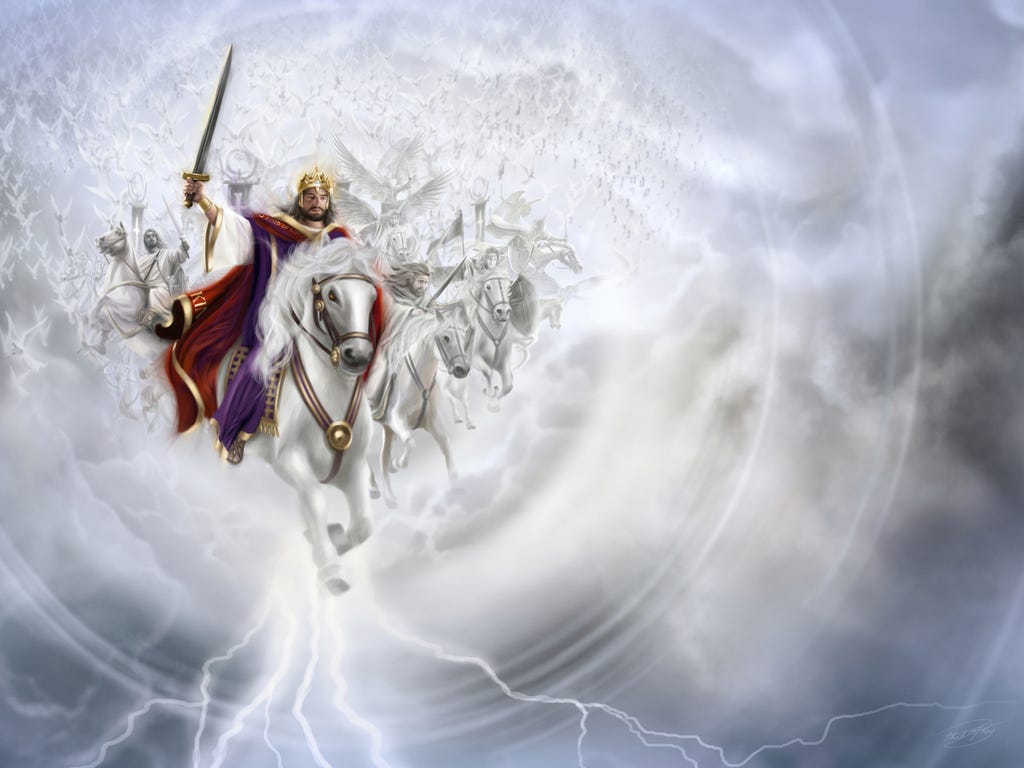
11 And I saw heaven opened, and behold a white horse; and he that sat upon him was called Faithful and True, and in righteousness he doth judge and make war.
12 His eyes were as a flame of fire, and on his head were many crowns; and he had a name written, that no man knew, but he himself.
13 And he was clothed with a vesture dipped in blood: and his name is called The Word of God.
14 And the armies which were in heaven followed him upon white horses, clothed in fine linen, white and clean.
15 And out of his mouth goeth a sharp sword, that with it he should smite the nations: and he shall rule them with a rod of iron: and he treadeth the winepress of the fierceness and wrath of Almighty God.
16 And he hath on his vesture and on his thigh a name written, KING OF KINGS, AND LORD OF LORDS.
17 And I saw an angel standing in the sun; and he cried with a loud voice, saying to all the fowls that fly in the midst of heaven, Come and gather yourselves together unto the supper of the great God;
18 That ye may eat the flesh of kings, and the flesh of captains, and the flesh of mighty men, and the flesh of horses, and of them that sit on them, and the flesh of all men, both free and bond, both small and great.
19 And I saw the beast, and the kings of the earth, and their armies, gathered together to make war against him that sat on the horse, and against his army.
20 And the beast was taken, and with him the false prophet that wrought miracles before him, with which he deceived them that had received the mark of the beast, and them that worshipped his image. These both were cast alive into a lake of fire burning with brimstone.
21 And the remnant were slain with the sword of him that sat upon the horse, which sword proceeded out of his mouth: and all the fowls were filled with their flesh.
Revelation 19:11–21
Jude 9
Yet Michael the archangel, when contending with the devil he disputed about the body of Moses, durst not bring against him a railing accusation, but said, The Lord rebuke thee.
Jude 9
Those who deny Christ as the archangel often cite the above verse, arguing that Michael did not rebuke Satan personally. Yet, the same overlook the very verse which Jude quotes directly from the book of the prophet Zechariah:
1 And he shewed me Joshua the high priest standing before the angel of the LORD, and Satan standing at his right hand to resist him.
2 And the LORD said unto Satan, The LORD rebuke thee, O Satan; even the LORD that hath chosen Jerusalem rebuke thee: is not this a brand plucked out of the fire?
Zechariah 3:1–2
We find yet another evidence pointing to Christ. The angel of the LORD Himself—the manifestation of Son of God in the Old Testament—does, in fact, rebuke Satan personally. To suggest that Michael does not rebuke Satan in Jude 9 is directly contradicted by the verse’s own context. Therefore, according to Jude, Michael is the angel of the LORD, which is Jesus.
1 Thessalonians 4:16
For the Lord himself shall descend from heaven with a shout, with the voice of the archangel, and with the trump of God: and the dead in Christ shall rise first:
1 Thessalonians 4:16
Our opposers presume the above text to mean that Christ is accompanied by the archangel’s voice, not that He is Michael Himself. Once again, such a position cannot be maintained without overlooking scripture at best, or at worst, being willingly ignorant of it. The gospel of John records the identity of the voice of the archangel, as revealed by the Lord Himself:
25 Verily, verily, I say unto you, The hour is coming, and now is, when the dead shall hear the voice of the Son of God: and they that hear shall live...
28 Marvel not at this: for the hour is coming, in the which all that are in the graves shall hear his voice,
29 And shall come forth; they that have done good, unto the resurrection of life; and they that have done evil, unto the resurrection of damnation.
John 5:25,28–29
Those who shall be raised in the first, or general resurrection shall hear the voice of who? “The voice of the Son of God.” And to whose voice shall the dead in Christ be raised from the grave? “The voice of the archangel.” By comparing scripture with scripture, the only conclusion is that these are the same one voice of the Lord of glory.
51 Behold, I shew you a mystery; We shall not all sleep, but we shall all be changed,
52 In a moment, in the twinkling of an eye, at the last trump: for the trumpet shall sound, and the dead shall be raised incorruptible, and we shall be changed.
53 For this corruptible must put on incorruption, and this mortal must put on immortality.
54 So when this corruptible shall have put on incorruption, and this mortal shall have put on immortality, then shall be brought to pass the saying that is written, Death is swallowed up in victory.
55 O death, where is thy sting? O grave, where is thy victory?
56 The sting of death is sin; and the strength of sin is the law.
57 But thanks be to God, which giveth us the victory through our Lord Jesus Christ.
1 Corinthians 15:51–57
Conclusion: Michael, the Son of God
The entirety of the testimony of scripture agrees, pointing to a single, biblically harmonious conclusion: Jesus Christ is the true Michael; the only archangel, the commander of the heavenly host. He is not a created angel, but the only begotten Son of God from everlasting. (Pro. 8:23; Mic. 5:2; John 3:18.)
It is our hope, by the grace of God, that our presentation and witness of this subject has blessed you in some way, whether this understanding be familiar or entirely new to you. May you be strengthened by the True and Faithful Witness (Rev. 3:14), looking unto Him as the author and finisher of our faith. (Heb. 12:2.)
God bless,
Brandon
Great article and explanation Brandon!