


PREFACE
Today, we are posting Part 2 of J.N. Andrews writing on The Sanctuary. A link to part 1 can be found at the end of this article. The original publication took place on January 6, 1853 in the Review and Herald.
In this part of the writing, Daniels opens with a brief explanation of the desolations, hosts, and sanctuaries in Daniel 8, as well as how we are to understand “the daily” that was taken away.
Following this, he then focuses the rest of the article on clearing up what the sanctuary is and isn’t, as well as describing the details related to the sanctuary that was located upon the earth.
God Bless,
Charles


ORIGINAL WRITING
(Any bolding of text has been added by me and is not part of the original writing)

THE SANCTUARY
BY J. N. ANDREWS
Continued
THERE ARE TWO “DESOLATIONS” IN Daniel 8. - This fact is made so plain by Josiah Litch, that I present his words:
“‘The daily sacrifice’ is the present reading of the English text. But no such thing as sacrifice is found in the original. This is acknowledged on all hands. It is a gloss or construction put on it by the translators. The true reading is, ‘the daily and the transgression of desolation,’ daily and transgression being connected together by ‘and;’ the daily desolation and the transgression of desolation. They are two desolating powers, which were to desolate the sanctuary and the host.” - Prophetic Expositions, Vol. I, page 127.
It is plain that the sanctuary and the host were to be trodden under foot by the daily and the transgression of desolation. The careful reading of verse 131 settles this point. And this fact establishes another, viz: that these two desolations are the two grand forms under which Satan has attempted to overthrow the worship and the cause of Jehovah. Mr. Miller’s remarks on the meaning of these two terms, and the course pursued by himself in ascertaining that meaning, is presented under the following head:

THE TWO DESOLATIONS ARE PAGANISM AND PAPACY
“I read on, and could find no other case in which it [the daily] was found, but in Daniel. I then [by the aid of a concordance] took those words which stood in connection with it, ‘take away;’ he shall take away the daily; ‘from the time the daily shall be taken away,’ etc. I read on, and thought I should find no light on the text; finally I came to 2 Thessalonians 2:7, 8. ‘For the mystery of iniquity doth already work; only he who now letteth will let, until he be taken out of the way, and then shall that wicked be revealed,’ etc. And when I had come to that text, O, how clear and glorious the truth appeared! There it is! That is the daily! Well, now, what does Paul mean by ‘he who now letteth,’ or hindereth? By ‘the man of sin,’ and the ‘wicked,’ Popery is meant. Well, what is it which hinders Popery from being revealed? Why, it is Paganism; well, then, ‘the daily’ must mean Paganism.” - Second Advent Manual, page 66.
It needs no argument to prove that the two grand forms of opposition, by which Satan has desolated the church, and trod under foot the sanctuary of the living God, are none other than Paganism and Popery. It is also a clear point that the change from one of these desolations to the other did occur under the Roman power. Paganism, from the days of the kings of Assyria down to the period when it became so far modified that it took the name of Popery, had been the daily [or, as Prof. Whiting renders it, “the continual”] desolation, by which Satan had stood up against the cause of Jehovah. And, indeed, in its priests, its altars and its sacrifices, it bore resemblance to the Levitical form of Jehovah’s worship. When the Christian form of worship took the place of the Levitical, a change in Satan’s form of opposition, and counterfeit worship, became necessary, if he would successfully oppose the worship of the great God.
And it is in the light of these facts that we are able to understand our Lord’s reference to the abomination of desolation in Matthew 24:15. It is evident that he there cites Daniel 9:26-27. Now, although we do not understand that Paganism in the year 70 had given place to Popery, we do understand that that same power which then appeared, modified somewhat in name and form, was the very power that should, as the abomination of desolation, wear out the saints of the Most High.
The language of Paul is to the point: “For the mystery of iniquity [Popery] doth already work; only he who now letteth will let, until he be taken out of the way. And then shall that Wicked be revealed, whom the Lord shall consume with the Spirit of his mouth, and shall destroy with the brightness of his coming.”2 That Paul refers to Paganism and Popery, none question. - And here is direct proof that Popery, the abomination of desolation, had in Paul’s day, already began to work. Nor was it a very great change of character when Satan transformed his counterfeit worship from Paganism to Popery. The same temples, altars, incense, priests and worshipers were ready, with little change, to serve as the appendages of the Papal abomination. The statute of Jupiter readily changed to that of Peter, the prince of the apostles; and the Pantheon, which had been the temple of all the gods, without difficulty became the sanctuary of all the saints. Thus the same abomination that desolated Jerusalem, in a degree changed and modified, became the wonderful desolator of the saints and martyrs of Jesus. And in its so called temple of God, it set at naught and trod under foot the true temple of Jehovah, and he who is its minister, Jesus Christ.
The change from Paganism to Popery is clearly shown in John’s view of the transfer of power from the dragon of Revelation 12, to the beast of Revelation 13. - And that they are essentially the same thing, is evident from the fact that both the dragon and the beast are represented with the seven heads; thus showing that, in a certain sense, either may be understood to cover the whole time. And in the same sense we understand that either abomination covers all the period. - Christ’s reference to the abomination of desolation3 is an absolute demonstration that Rome is the little horn of Daniel 8:9-14.
Having shown that there are two desolations, by which the sanctuary and the host are trodden down, we now notice the fact that there are

TWO OPPOSING SANCTUARIES IN Daniel 8
To the careful reader this fact will at once appear. They are as follows: First, the sanctuary of the daily desolation.4 Second, the sanctuary which the daily and the transgression of desolation were to tread under foot.5 The one is the sanctuary of Satan; the other is the sanctuary of Jehovah of hosts. The one is the dwelling place of “all the gods;” the other is the habitation of the only living and true God.
If it be said that a sanctuary is never connected with heathen and idolatrous worship, we cite the direct testimony of the Bible. Heathen Moab had a sanctuary. And that sanctuary was a place of prayer and worship for that heathen nation.6 The chapel erected by the king of Israel at Bethel, as a rival to the temple of Jehovah at Jerusalem7 was called his sanctuary.8 And the places in which idolatrous Israel [the ten tribes] worshiped, are called sanctuaries.9 The same is true of idolatrous Tyre.10 Attention is called to the following from Apollos Hale:
“What can be meant by the ‘sanctuary’ of Paganism? Paganism, and error of every kind, have their sanctuaries, as well as truth. These are the temples or asylums consecrated to their service. - Some particular and renowned temple of Paganism may, then, be supposed to be here spoken of. - Which of its numerous distinguished temples may it be? One of the most magnificent specimens of classic architecture is called the Pantheon. The name signifies ‘the temple or asylum of all the gods.’ The ‘place’ of its location is Rome. The idols of the nations conquered by the Romans were sacredly deposited in some niche or apartment of this temple, and in many cases became objects of worship by the Romans themselves. Could we find a temple of Paganism that was more strikingly ‘his sanctuary?’ Was Rome, the city or place of the Pantheon, ‘cast down’ by the authority of the state? Read the following well-known and remarkable facts in history: ‘The death of the last rival of Constantine had sealed the peace of the empire. - Rome was once more the undisputed queen of nations. But, in the hour of elevation and splendor, she had been raised to the edge of a precipice. Her next step was to be downwards and irrecoverable. The change of the government to Constantinople still perplexes the historian. Constantine abandoned Rome, the great citadel and throne of the Caesars, for an obscure corner of Thrace, and expended the remainder of his vigorous and ambitious life in the double toil of raising a colony into the capital of his empire, and degrading the capital into the feeble honors and humiliated strength of a colony.’” - Second Advent Manual, page 68.
And not only did Satan possess himself of a rival to the sanctuary of Jehovah in the period of Pagan worship, but, throughout the Christian dispensation, has that arch fiend possessed a rival temple of God.11 Thus much for the rival sanctuary of Satan. The sanctuary of Jehovah remains to be noticed at length. Connected with these two sanctuaries,

THERE ARE TWO HOSTS IN Daniel 8:9-13.
The one is the host that was given to the little horn against the daily, when it had filled its measure of transgression; and by the aid of this host, the little horn was able to cast down the truth.12 This host is mentioned in Daniel 11:31. By this host, the sanctuary of the daily desolation, and its services, were transferred to the transgression, or abomination of desolation. This host is the forces of Satan, and it is intimately associated with his sanctuary.
The other host is “the host of heaven.”13 Michael is the Prince of this host.14 Against the Prince of this host the little horn stands up.15 [Prof. Whiting remarks that in the original, “Prince of the host” occurs in Joshua 5:14.] None dispute that the host of whom Michael [Christ] is Prince, is the church of the living God.16 This host, the true church, is fitly represented by a green olive tree.17 And when some of the branches [members of the Jewish church] were broken off through unbelief, others were grafted in from the Gentiles, and thus the host continues to exist.18 This host, or church, is the worshipers of Jehovah, and is intimately connected with his sanctuary. That sanctuary we are now prepared to consider.

WHAT IS THE SANCTUARY OF JEHOVAH?
Before answering this question, we present the definition of the word sanctuary: “A holy place.” - Walker. “A sacred place.” - Webster. “A holy or sanctified place, a dwelling-place of the Most High.” - Cruden. A dwelling-place for God.19 Thus much for the meaning of the word. We now inquire respecting its application.
IS THE EARTH THE SANCTUARY?
To this question we answer emphatically: It is not. And if we are requested to prove a negative, we offer the following reasons:
The word sanctuary is used 145 times in the Bible, and it is not in a single instance applied to the earth. Hence there is no authority for this view, except that of man.
Every one knows that the earth is neither a dwelling-place of God, nor yet a holy, or sacred place. Those, therefore, who affirm that it is the sanctuary of God, should know better than to make such a statement.
In almost every instance in which the word sanctuary occurs in the Bible, [and the exceptions nearly all refer to Satan’s rival sanctuary,] it refers directly to another definite object which God calls his sanctuary. Hence, those who teach that the earth is the sanctuary of the Lord of hosts, contradict the positive testimony of Jehovah, an hundred times repeated.
For the benefit of those who think that the earth will become the sanctuary after it has been cleansed by fire, we add that God does not even then call it his sanctuary; but simply “the place” of its location.20 The earth, then, is not the sanctuary, but merely the place where it will be located hereafter.

IS THE CHURCH THE SANCTUARY?
We answer: It is not. The following reasons in support of this answer are to the point:
The Bible never calls the church the sanctuary.
In a great number of texts, God has called another object his sanctuary, and has uniformly associated the church with that object, as the worshipers; and that sanctuary itself, as the place of that worship, or toward which their prayer was directed.21
The following inference is all that we have ever seen urged in favor of this view. God has many times called the tabernacle or temple, which are the patterns of the true, his “sanctuary.” And because that the church is spiritually called the temple of God, some have supposed that they were at liberty to call the church the sanctuary.
But there is one text that some may urge. - It is this: “When Israel went out of Egypt, the house of Jacob from a people of strange language; Judah was his sanctuary, and Israel his dominion.”22 But, at most, this would only prove that one of the twelve tribes was the sanctuary, and that the whole church was not. But if the fact be remembered that God chose Jerusalem,23 which was in Judah,24 as the place of his sanctuary,25 we think the following from another Psalm will fully explain the connection between Judah and the sanctuary of Jehovah, and show that Judah was the tribe with which God designed to locate his habitation: “But chose the tribe of Judah, the mount Zion which he loved. And he built his sanctuary like high palaces,26 like the earth which he hath established for ever.”27
But if a single text could be adduced to prove that the church is called a sanctuary, the following plain fact would prove beyond controversy that it is not the sanctuary of Daniel 8:13, 14. The church is represented in Daniel 8:13, by the word “host.” This, none will deny. “To give both the sanctuary and the host to be trodden under foot.” Then the church and the sanctuary are two things. The church is the host or worshipers; the sanctuary is the place of that worship, or the place toward which it is directed.

IS THE LAND OF CANAAN THE SANCTUARY?
Of the 145 times in which the word sanctuary occurs in the Bible, only two or three texts have been urged, with any degree of confidence, as referring to the land of Canaan. Yet strangely enough, men have claimed that the supposed meaning of these two or three texts ought to determine the signification of the word in Daniel 8:13-14, against the plain testimony of more than a hundred texts! For none can deny that in almost every instance in which the word does occur, it refers directly to the typical tabernacle, or else to the true, of which that was but the figure or pattern. But we now inquire whether the two or three texts in question do actually apply the word sanctuary to the land of Canaan. They read as follows:
“Thou shalt bring them in, and plant them in the mountain of thine inheritance, in the place, O Lord, which thou hast made for thee to dwell in, in the sanctuary, O Lord, which thy hands have established.” Exodus 15:17.
“And he led them on safely, so that they feared not; but the sea overwhelmed their enemies. And he brought them to the border of his sanctuary, even to this mountain, which his right hand had purchased. And he built his sanctuary like high palaces, like the earth which he hath established for ever.” Psalm 78:53, 54, 69.
The first of these texts, it will be noticed, is taken from the song of Moses after the passage of the Red Sea. It is a prediction of what God would do for Israel. The second text was written about 500 years after the song of Moses. What Moses utters as a prediction, the Psalmist records as a matter of history. Hence the Psalm is an inspired commentary on the song of Moses.
If the first text be read without the other, the idea might be gathered that the mountain was the sanctuary, though it does not directly state this. - Even as one might get the idea that the tribe of Judah was mount Zion, were they to read only the expression “but chose the tribe of Judah, the mount Zion which he loved,”28 and omit those texts which inform us that mount Zion was the city of David, a part of Jerusalem29 and was located in Judah, as one of its cities.30
But if the second text be read in connection with the first, it destroys the possibility of such an inference. The Psalmist states that the mountain of the inheritance was the border of the sanctuary. - And that God, after driving out the heathen before his people, proceeded to build his sanctuary like high palaces. See 1 Chronicles 29:1.
The land of Canaan was the mountain of the inheritance.31
That mountain was the border of the sanctuary.32
In that border God built his sanctuary.33
In that sanctuary God dwelt.34
In that border the people dwelt.35
These facts demonstrate that the same Spirit moved both those “holy men of old.” These texts perfectly harmonize, not only with each other, but with the entire testimony of the Bible, respecting the sanctuary. If the reader still persists in confounding the sanctuary with its border, the land of Canaan, we request him to listen while a king of Judah points out the distinction:
“Art not thou our God, who didst drive out the inhabitants of this land before thy people Israel, and gavest it to the seed of Abraham thy friend for ever? And they dwelt therein, and have built thee a sanctuary therein for thy name, saying, If, when evil cometh upon us, as the sword, judgment, or pestilence, or famine, we stand before this house, and in thy presence, (for thy name is in this house,) and cry unto thee in our affliction, then thou wilt hear and help.” 2 Chronicles 20:7-9.
This language is a perfect parallel to that of Psalm 78:54-55, 69. In the clearest manner it points out the distinction between the land of Canaan, and the sanctuary which was built therein; and it does clearly teach that that sanctuary was the house erected as the habitation of God.
But there is another text by which some attempt to prove that Canaan is the sanctuary.
“The people of thy holiness have possessed it but a little while: our adversaries have trodden down thy sanctuary.” Isaiah 63:18.
No one offers this as direct testimony. As it is only an inference, a few words are all that is needed.
When the people of God’s holiness were driven out of the land of Canaan, (as here predicted by the prophet, who uses the past tense for the future,) not only were they dispossessed of their inheritance, but the sanctuary of Jehovah built in that land, was laid in ruins. This is plainly stated in 2 Chronicles 36:17-20.
The next chapter testifies that the prophet had a view of the destruction of God’s sanctuary, as stated in the text quoted from 2Chronicles. This explains the whole matter.36
A fourth text may occur to some minds as conclusive proof that Canaan is the sanctuary. We present it, as it is the only remaining one that has ever been urged in support of this view.
“The glory of Lebanon shall come unto thee, the fir-tree, the pine-tree, and the box together, to beautify the place of my sanctuary; and I will make the place of my feet glorious.” Isaiah 60:13.
This text needs little comment. The place of God’s sanctuary, we fully admit, is the land of Canaan, or the new earth, for Isaiah refers to the glorified state. And as God has promised to set his sanctuary in that place,37 the meaning of the text is perfectly plain. But if any still assert that the place of the sanctuary is the sanctuary itself, let them notice that the same text calls the same “place” the place of the Lord’s feet; and hence the same principle would make the land of Canaan the feet of the Lord! The view that Canaan is the sanctuary is too absurd to need further notice. And even were it a sanctuary, it would not even then be the sanctuary of Daniel; for the prophet had his eye upon the habitation of Jehovah.38 Canaan was only the place of God’s sanctuary or habitation.
We have found that the earth is not the sanctuary, but simply the territory where it will finally be located. That the church is not the sanctuary, but simply the worshipers connected with the sanctuary. And that the land of Canaan is not the sanctuary, but that it is the place where the typical sanctuary was located. Now we inquire for the sanctuary itself.

BIBLE VIEW OF THE SANCTUARY
The sanctuary of the Bible is the habitation of Jehovah. It includes, first, the tabernacle pitched by man, which was the pattern of the true; and second, the true tabernacle which the Lord pitched and not man. The tabernacle erected by man, as the pattern of the true, embraced, first, the tabernacle of Moses, second, the temple of Solomon, and, third, the temple of Zerubbabel. The true tabernacle of God is the great original of which Moses, Solomon and Zerubbabel erected “figures,” “patterns” or “images.”
We trace the pattern of the true from the time it was erected by Moses, until it was merged in the larger and more glorious pattern which Solomon caused to be established. We trace this building down to the period when it was overthrown by Nebuchadnezzar, and suffered to remain in ruins through the Babylonish captivity. And from the time that Zerubbabel rebuilt the sanctuary, we trace the history of the pattern until we reach the true tabernacle, the great sanctuary of Jehovah. - We trace the history of the tabernacle from the time that our Lord entered it to minister in “the holy places” for us, forward to the time when it shall be located on the New Earth, when the tabernacle and sanctuary of God shall be with his people for ever.
We are compassed about with a great cloud of witnesses. To the law and to the testimony. We gather our first instruction respecting the sanctuary, from the book of Exodus. In chapter 24, we learn that Moses went up into the cloud that enshrouded the God of Israel, upon the Mount Sinai, and that he was there forty days. It was during this period that the building of the sanctuary was explained to Moses, and the pattern of it shown to him in that mount.39 The next chapter commences with

THE COMMANDMENT TO ERECT THE SANCTUARY
“And the Lord spake unto Moses, saying, Speak unto the children of Israel, that they bring me an offering: of every man that giveth it willingly with his heart ye shall take my offering. And this is the offering which ye shall take of them, gold, and silver, and brass, and blue, and purple, and scarlet, and fine linen, and goat’s hair, and rams’ skins dyed red, and badger’s skins, and shittim-wood, oil for the light, spices for anointing oil, and for sweet incense, onyx stones, and stones to be set in the ephod, and in the breast-plate. And let them make me a sanctuary; that I may dwell among them. According to all that I shewed thee, after the pattern of the tabernacle, and the pattern of all the instruments thereof, even so shall ye make it.” Exodus 25:1-9.
We have here learned several important facts.
The sanctuary was the habitation of God. It was erected for this express purpose, that God might dwell among his people. And Moses had his eye upon this habitation, or sanctuary, in that very chapter in which he is supposed by some to teach that the land of Canaan is the sanctuary. “He is my God,” says Moses, “and I will prepare him an habitation.”40 It is plain that even then, Moses understood the difference between the habitation of Jehovah, and the place of its location.
The Sanctuary, which God commanded Moses to erect, was the tabernacle. The tabernacle of witness was the sanctuary of God.
Moses was solemnly enjoined to make the sanctuary, and all its vessels, according to the pattern showed to him in that place. Hence, we are now to have a model of the habitation of God set before us.

THE PLAN OF THE SANCTUARY
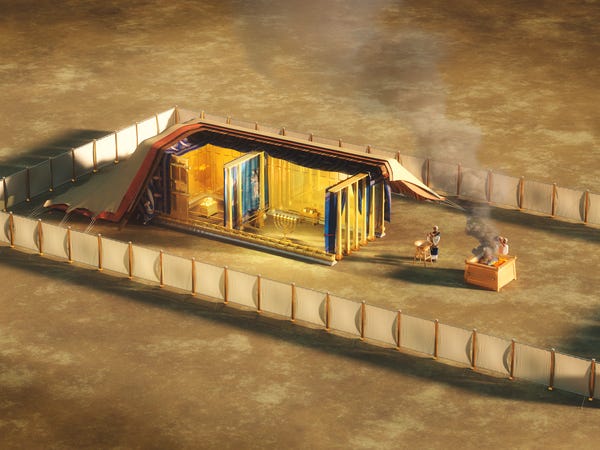
Its walls on the north, the west, and the south sides, were formed of upright boards, set in sockets of silver. These boards were ten cubits in length, by one cubit and a half in breadth. And as there were twenty of them on each of the two sides, we learn that it was thirty cubits in length and ten in height. In the same manner we ascertain that it was about ten cubits in width.41 The sockets in which the boards were set, are termed, “the sockets of the sanctuary.”42 Five bars running the length of the sides, and passing through rings in the boards, joined them all together. And the whole was overlaid with gold. The sanctuary was covered with four different coverings. The east end was closed by a vail, or hanging, called the door of the tent, or tabernacle. A second vail divided the tabernacle into two parts called the holy place, and the holiest of all.43

THE VESSELS OF THE SANCTUARY
These were all made after the pattern which the Lord showed to Moses.44 They were as follows:
THE ARK. This was a small chest about four feet six inches in length, and about two feet six inches in width and height, overlaid with pure gold, within and without. This was made for the express purpose of containing God’s testament, the ten commandments.45
THE MERCY-SEAT. This was the top of the ark. On either end of it stood a cherub. The cherubim and the mercy-seat being one solid work of beaten gold.46
THE ALTAR OF INCENSE. This was overlaid with gold, and was about three and a half feet in height, and nearly two feet square. It was for the purpose of burning incense before God.47
THE GOLDEN CENSER. This was used to burn incense before the Lord, particularly in the holiest.48
THE CANDLESTICK, with its seven lamps, was one solid work of beaten gold, about the weight of a talent. It was made after the express pattern shewed to Moses.49
THE TABLE OF SHEW-BREAD. This was about three and a half feet in length, two and a half in height, and two in width. It was overlaid with pure gold, and on it shew-bread was always kept before the Lord.50
THE ALTAR OF BURNT-OFFERING. This was about nine feet square, and nearly five and a half feet in height. It was overlaid with brass, and was, as its name implies, used for the purpose of offering up sacrifices to God.51
THE LAVER. This was made of brass, and contained water for the use of the priests.52 The court of the tabernacle was one hundred cubits in length, by fifty in breadth, and five cubits, or about nine feet, in height.53
God called by name those who were to execute this work, and filled them with the spirit of wisdom.54 They knew “how to work all manner of work for the service of the sanctuary.”55 They received the offering of the children of Israel for “the service of the sanctuary.”56 They came from “the work of the sanctuary,”57 and testified that more was offered than could be used. And Moses commanded that none should “make any more work for the offering of the sanctuary.”58 The construction of every part of the sanctuary is minutely described in [Exodus] Chaps. 36 - 39.59 Every thing was then submitted to Moses for inspection, and he pronounced the work such as God commanded, viz: a true pattern.60 God then commanded Moses to set up the sanctuary, and to place every thing in order.61

MOSES ERECTS THE SANCTUARY
And Moses reared up the tabernacle, and set up its boards in the sockets of silver, and united them together by the bars, and spread over the whole the covering of the tabernacle. He then placed the testimony in the ark, and set the mercy-seat upon it, and carried the ark into the tabernacle.62 He then hung up the vail in front of the ark, and thus divided between the holy places.63 He placed the table without the vail, on the north side of the holy place, and set the bread in order upon it.64 He then placed the candlestick on the south side of the holy place, and lighted its lamps before the Lord.65 He placed the golden altar before the vail, in the holy place, and burned sweet incense upon it.66 He set up the hanging for the door of the sanctuary, and he placed the altar of burnt offering at the door, and set the laver between the tabernacle and this altar, and around the whole, he set up the court of the tabernacle.67
The sanctuary erected for the habitation of Jehovah68 is now ready to receive the King Eternal.

GOD TAKES POSSESSION OF THE SANCTUARY
“Then a cloud covered the tent of the congregation, and the glory of the Lord filled the tabernacle. And Moses was not able to enter into the tent of the congregation, because the cloud abode thereon, and the glory of the Lord filled the tabernacle.” Exodus 40:34-35
We now have found the habitation or sanctuary of the Lord. In the book of Exodus, Moses calls this building the sanctuary, at least eleven times. But do you ask for the words of the New Testament on the point? Then listen.

PAUL’S VIEW OF THE SANCTUARY OF THE FIRST COVENANT
“Then verily the first covenant had also ordinances of divine service, and a worldly sanctuary. For there was a tabernacle made; the first, wherein was the candlestick, and the table, and the shew-bread; which is called the sanctuary. And after the second vail, the tabernacle which is called the Holiest of all; which had the golden censer, and the ark of the covenant overlaid round about with gold, wherein was the golden pot that had manna, and Aaron’s rod that budded, and the tables of the covenant; and over it the cherubim of glory shadowing the mercy-seat.” Hebrews 9:1-5; 13:11.
It is settled, therefore, that we have the right view of this subject thus far, and that the tabernacle of God, and not the land of Canaan, was the sanctuary.

THE WORLDLY SANCTUARY WAS THE PATTERN OF THE TRUE
“After the pattern of the tabernacle, and the pattern of all the instruments thereof even so shall ye make it.” “And look that thou make them after their pattern, which was shewed thee in the mount.” Exodus 25:9, 40.
“And thou shalt rear up the tabernacle according to the fashion thereof which was shewed thee in the mount.” Exodus 26:30.
“As it was shewed thee in the mount so shall they make it.” Exodus 27:8.
“According unto the pattern which the Lord had shewed Moses, so he made the candlestick.” Numbers 8:4
“Our fathers had the tabernacle of witness in the wilderness, as he had appointed, speaking unto Moses, that he should make it according to the fashion that he had seen.” Acts 7:44
“Who serve unto the example and shadow of heavenly things, as Moses was admonished of God when he was about to make the tabernacle; for, see, saith he, that thou make all things according to the pattern shewed to thee in the mount.” Hebrews 8:5
“It was therefore necessary that the patterns of things in the heavens should be purified with these; but the heavenly things themselves with better sacrifices than these. For Christ is not entered into the holy places made with hands, which are the figures of the true.” Hebrews 9:23-24.
From these texts we learn two important facts.
1. We are many times certified that the tabernacle of witness was made according to the pattern which God shewed to Moses.
2. That that pattern was a representation of the heavenly sanctuary itself.69
We trace the history of the sanctuary in the book of Leviticus. Every instance in which the word occurs, it is admitted, refers to the tabernacle of the Lord. The blood of sin-offering was sprinkled “before the vail of the sanctuary.”70 For offering strange fire before the Lord in his tabernacle, two of the sons of Aaron were slain. They were then carried “from before the sanctuary.”71 The unclean were not to “come into the sanctuary,” or tabernacle.72 “The holy sanctuary” was to be cleansed.73 “Ye shall keep my Sabbaths, and reverence my sanctuary: I am the Lord.”74 Those who worshiped Molech, defiled the Lord’s sanctuary.75 “Sanctuaries,” used for the two holy places.76 - See also Jeremiah 51:51. God commanded that the high priest should not “go out of the sanctuary, nor profane the sanctuary of his God,” to mourn for the dead.77
God placed his tabernacle in the charge of the tribe of Levi, who pitched around it.78 Under the standard of Judah on the east, of Reuben on the south, of Ephraim on the west, and of Dan on the north, the tribes of Israel were to pitch around the tabernacle in four great bodies, during their sojourn in the wilderness.79 God then divided the tribe of Levi according to his three sons, Gershon, Kohath and Merari. These three divisions were to pitch severally on the west, south and north sides of the tabernacle.80 The Kohathites were to keep “the charge of the sanctuary,” and also of “the vessels of the sanctuary.”81 And Eleazar the priest was to have the oversight of those who thus kept “the charge of the sanctuary.”82 But on the east side of the tabernacle, Moses, Aaron and his sons were to encamp and keep “the charge of the sanctuary.”83
When the camp was to set forward, the priest were to take down the tabernacle,84 and cover the sacred vessels, and “all the instruments of ministry wherewith they minister in the sanctuary;”85 “and when they have made an end of covering the sanctuary, and all the vessels of the sanctuary,” the sons of Kohath came near to bear it.86 And God commanded that Eleazar should have “the oversight of all the tabernacle, and of all that therein is, in the sanctuary.”87 “The service of the sanctuary,” belonging unto the Kohathites, was to bear it upon their shoulders.88 The Levites were given to Aaron to do the service of the tabernacle, that there be no plague “when the children of Israel come nigh unto the sanctuary.”89 “The Kohathites set forward bearing the sanctuary.”90
The priests were to “bear the iniquity of the sanctuary.”91 The Levites were not to “come nigh the vessels of the sanctuary.”92 And the priests should “keep the charge of the sanctuary.”93 The man that neglected purification “defiled the sanctuary of the Lord.”94 “The shekel of the sanctuary,” or tabernacle, was the standard in Israel. The word sanctuary, meaning the habitation of God, occurs in this connection twenty-five times.95
The word sanctuary does not occur in the book of Deuteronomy. One chapter refers to it as “the tabernacle of the congregation.”96 We have traced the history of the sanctuary, from the time that it was erected, through the period of Israel’s sojourn in the wilderness. From Acts 7:45, we learn that the tribes of Israel carried it with them into the promised land. In the book of Joshua it is called the house of God, or tabernacle, and we learn that it was set up at Shiloh.97 It is called the Lord’s tabernacle.98 It is called “the sanctuary of the Lord.”99 In the book of Judges it is simply called “the house of God,” located at Shiloh.100 In 1 Samuel it is termed the house of the Lord.101 In 1 Samuel 1:9; 3:3, it is called the temple of the Lord. In 1 Samuel 2:32, it is called by God, “my habitation,” or tabernacle, margin. It still abode in Shiloh.102

GOD FORSAKES THE SANCTUARY
For the gross wickedness of the priests and people,103 God forsook his habitation, and gave his glory [the ark of his testament] into the hands of the enemy, the Philistines.104 It does not appear that after the ark of God was taken from the tabernacle at Shiloh, and God there forsook his habitation, that his glory, or the ark of his covenant, ever returned to that building. The other sacred vessels remained with the tabernacle, which in the days of Saul seems to have been located at Nob;105 and in the days of David, at Gibeon.106 And here we leave it for the present to follow the ark.
The ark was taken by the Philistines, and kept in their land seven months. In which time they were smitten with sore plagues, and Dagon, their god, twice fell before it. They then returned it to Israel to Beth-shemesh. At this place 50,000 of Israel were smitten for looking into the ark.107 From thence it was removed to Kirjathjearim to the house of Abinadab, where it abode twenty years.108 In this period it is said that all Israel “lamented after the Lord.” - From this place it was removed to the house of Obed-edom where it abode three months.109 From this place David removed it to his own city, Jerusalem, and placed it in a tabernacle which he had pitched.110 It was at this time, when the Lord had given David rest from all his enemies, and he dwelt securely in his own house, that the habitation of his God came before his mind.

DAVID DESIRES TO BUILD A GLORIOUS SANCTUARY
The situation of God’s house came into the mind of David, and he “desired to find a tabernacle for the God of Jacob.”111 He set this matter before Nathan the prophet, who told him, “Do all that is in thy heart, for God is with thee.” But that night God charged Nathan to say to David, “Thus saith the Lord, thou shalt not build me a house to dwell in.”112 This was because David had been a man of war, and had shed blood abundantly. But God promised that Solomon, his son, should build the house.113 Then David proceeded to make great preparation for the building.114 The place where the angel of the Lord appeared to David, at the time when the plague was stayed, viz: the threshing-floor of Ornan the Jebusite,115 upon Mount Moriah,116 which was near to Mount Zion, was the place of God’s habitation.117 And here, “like high palaces,” God’s sanctuary was built.118

SOLOMON AND THE PRINCES CHARGED TO BUILD THE SANCTUARY
“Now set your heart and your soul to seek the Lord your God; arise therefore, and build ye the sanctuary of the Lord God, to bring the ark of the covenant of the Lord, and the holy vessels of God, into the house that is to be built to the name of the Lord.” 1 Chronicles 22:19.
Take heed now; for the Lord hath chosen thee to build an house for the sanctuary; be strong, and do it.” 1 Chronicles 28:10.
Then David gave to Solomon explicit directions respecting the building of the sanctuary.119 A full account of the erection of this glorious sanctuary may be read in 1 Kings 6; 7; 2 Chronicles 3; 4:1 it occupied seven years and six months in building, and when finished was of wonderful magnificence. It principally differed from the tabernacle, in being an enlargement of that plan, and in being a permanent, instead of temporary building. The vessels of the sanctuary were also increased in size and number.

THE TABERNACLE GIVES PLACE TO THE TEMPLE
Every thing being finished in the temple of the Lord, and all Israel assembled at its dedication, we read as follows:
“And they brought up the ark of the Lord, and the tabernacle of the congregation, and all the holy vessels that were in the tabernacle, even those did the priests and the Levites bring up.” “And the priests brought in the ark of the covenant of the Lord unto his place, into the oracle of the house, to the most holy place, even under the wings of the cherubims.” 1 Kings 8:4, 6.
The tabernacle which had been at Gibeon for a long while, was as we have here read, brought up to the temple of the Lord, and the sacred vessels, and the priesthood, were transferred to that more glorious sanctuary. The ark which had for some time been kept at Jerusalem, was carried into the most holy place in the temple. And now the habitation for the God of Jacob, is complete.

GOD TAKES POSSESSION OF THE SANCTUARY
“And it came to pass, when the priests were come out of the holy place, that the cloud filled the house of the Lord, so that the priests could not stand to minister because of the cloud; for the glory of the Lord had filled the house of the Lord. - Then spake Solomon, The Lord said that he would dwell in thick darkness. I have surely built thee an house to dwell in, a settled place for thee to abide in for ever.” 1 Kings 8:10-12
The Shekinah, or visible glory of God, which had dwelt in the tabernacle, has now passed into the temple, and that temple is thenceforward the sanctuary of the Lord God.

THE TEMPLE WAS A PATTERN OF THE TRUE SANCTUARY
“Then David gave to Solomon his son the pattern of the porch, and of the houses thereof, and of the treasuries thereof, and of the upper chambers thereof, and of the inner parlors thereof, and of the place of the mercy-seat, and the pattern of all that he had by the Spirit, of the courts of the house of the Lord, and all the chambers round about, of the treasuries of the house of God, and of the treasuries of the dedicated things; also for the courses of the priests and the Levites, and for all the work of the service of the house of the Lord, and for all the vessels of service in the house of the Lord.” “All this, said David, the Lord made me understand in writing by his hand upon me, even all the works of this pattern.” 1 Chronicles 28:11-13, 19.
“Thou hast commanded me [Solomon] to build a temple upon thy holy mount, and an altar in the city wherein thou dwellest, a resemblance of the holy tabernacle, which thou hast prepared from the beginning.” Wisdom of Solomon 9:8.
“The pattern of things in the heavens;” “the holy places made with hands which are the figures of the true.” Hebrews 9:23, 24.
[TO BE CONTINUED.]

OTHER PARTS IN THIS SERIES

SCRIPTURE INDEX
Psalm 20:2; 28:2, margin; Psalm 29:2, margin; Psalm 63:2; 68:24; 73:17; 134:2; 150:1; 5:7
1 Samuel 4; 5; 6