


PREFACE
The following writing comes from an article originally written by J.N. Loughborough in the March 26 edition of the 1857 Review and Herald publication. It was titled “A Letter to a Friend on the Seven Churches” and addresses the prophetic nature of the seven churches in Revelation 2-3 and how they relate to the seven distinct periods of church history (most of which have been completely fulfilled now).
This very important truth is largely missed in Protestantism, and it has a particular relevance to those of us who are living today. I hope you enjoy this writing as we seek to restore truth to its proper place.
God Bless,
Charles


ORIGINAL WRITING
(Any bolding of text has been added by me and is not part of the original writing)

A LETTER TO A FRIEND, ON THE SEVEN CHURCHES
BY J. N. LOUGHBOROUGH
(Concluded)
We shall now endeavor to give the chronology of the seven states of the gospel church, as set forth by the seven churches.1 We shall not pass into all the minute details of events connected with these churches, in this investigation; for they have been, heretofore set before the readers of the Review; but will try and notice some prominent points which seem to have a bearing in giving the chronology of each church. As we have before stated, we shall locate the prophecy of the seven churches in the same manner that we would locate any other prophecy that has not a definite time specified for its events to transpire; i.e., by the fulfillment of its specifications.

CHURCH OF EPHESUS
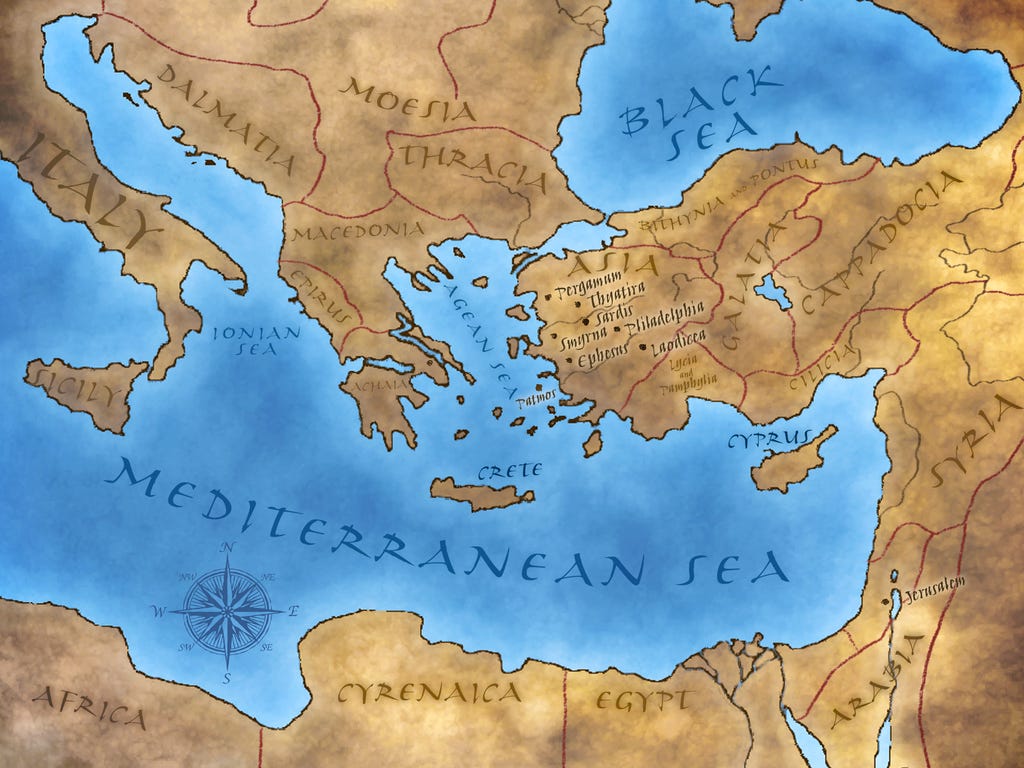
This name, or church we understand covers the apostolic church, from its rise till it began to fall away to that extent that it became obnoxious in the sight of the Lord, and he by his Spirit and truth called out a people from the apostate mass to form a second church. The Ephesus church had “tried them that say they are apostles and are not.”2 Trying apostles was the work of the whole apostolic church, and not simply of a single church located in the city of Ephesus. The case recorded in Acts 15, was at Jerusalem, and the church which found that the decision of that convention proved those professed apostles who had taught them to keep the law of Moses, to be liars, was not the church of Ephesus. Letters were sent to Antioch, Syria and Cilicia. It seems also that the church at Corinth had been troubled with false apostles. See 2 Cor. 11:13. But Paul records no such trial of apostles in the city of Ephesus in his testimony to them. This work we understand, as we have already stated, was the work of the whole apostolic church.
The Ephesus church had suffered for his name’s sake. The great testing truth in the apostolic age was to confess the name of Jesus, and “whosoever would confess that Jesus was the Christ should be put out of the synagogue.”3
“For my name’s sake thou hast not fainted.”4 This we understand shows the zeal with which the apostolic church had labored, enduring privations and afflictions, to introduce the gospel. Paul after summing up all his trials, could call them a “light affliction which is but for a moment.”5
“Thou hast left thy first love.”6 I understand this testimony describes the majority of the members of that church, just as the Lord was about, to set them aside. Even while the apostle Paul was alive the “mystery of iniquity,”7 was at work. And as Enfield says in his Philosophy, The first witness of Christianity had scarcely left the world when some of the fathers seemed intent on uniting heathen philosophy with Christianity. And thus they early commenced to clothe the doctrines of Christianity in an allegorical dress. Moshiem says that in this manner they had (in the third century) “degenerated much from primitive simplicity.” “Remember therefore from whence thou art fallen, and repent, and do the first works, or else I will come unto thee quickly, and remove thy candlestick out of his place, except thou repent.”8 They are a fallen church and about to be set aside when this testimony has its application to them. When this church as a mass refused to arouse from their fallen state, it was just as necessary that the true hearted ones should come out in a reform, as it is that God’s people should be called out of modern Babylon. And thus we understand it was that the Ephesus candlestick was set aside, and the Smyrna candlestick brought in. The time of this transition we understand was near the close of the third century.

THE CHURCH OF SMYRNA
We understand to be the second state of the church. This word Smyrna is transferred from the Greek to the English—not translated. It signifies myrrh. This church then was a sweet smell in the nostrils of the Lord. This church was to have “tribulation.” “The Devil should cast some of them into prison.”9 They were to be destroyed by violent means, and tribulation was to continue ten days. This being prophetic time would signify ten years. We understand that this had its accomplishment from A.D. 303 to 313, during the tenth persecution of the church under Diocletian. Probably “the Devil,” which performed his work against them, has particular reference to the “Dragon, that old serpent, the Devil,”10 Pagan Rome; for we understand that the Devil persecuted through that power as he had done through no other power before. For the history of this ten years’ persecution on the church, see the article in the Review, [Vol. IX, No. 15,] on “The Seven Churches, Seven Seals, and Four Beasts.
No accusation is brought against the Smyrna church. Neither is the Pergamos church which followed it, said in so many words to have continued faithful while the mass of the Smyrna church fell away; yet there is testimony made to the Pergamos church which conveys the idea to my mind that the mass out of which they had been called did fall, and thus conveys the idea that in that manner the second candlestick was removed.

THE PERGAMOS CHURCH.
The manner of the transition of the true church into the Pergamos state is conveyed to my mind by Rev 2:13: “I know thy works, and where thou dwellest, even where Satan’s seat is, and thou holdest fast my name.” Here is proof that there had been a falling away by some. “Thou holdest fast my name,” (some then had not held fast,) “and hast not denied my faith, even in those days when Antipas was my faithful martyr, who was slain among you, where Satan dwelleth.” Then there had been those in the days when this church arose, that had denied Christ’s name, or apostatized. This work was said to have been accomplished “where Satan’s seat is.” Now there is no evidence that occurs to my mind that Satan had taken his seat in the city of Pergamos; but the seat of that power called, “the Devil, and Satan,” [Rev 12,] through which the Devil wrought so effectually, was the city of Rome. And here was the great focal point where, from the ascension of Constantine A.D. 312, to the establishment of the Papacy, decrees went forth against those who held the gospel truths as sacred, which that power was persecuting.
The following will show that our supposition in regard to the falling away of the Smyrna church, while some held fast, is not without foundation. It is stated by the historian, that when Constantine proposed to assist the christians, and protected them from their persecutions; if they would come and enlist under his banner, and help fight his battles, the young men immediately consented to it, but the old men shook their heads, saying, “It’s a bad omen.”
On the word Antipas used in the testimony to this church says Wm. Miller, “It is supposed that Antipas was not an individual, but a class of men who opposed the power of the bishops, or popes in that day, being a combination of two words, Anti, opposed, and Papas, father, or pope.” We find by tracing the history of the church during the fourth and fifth centuries, that many decrees went forth from that power enforcing under severe penalties, doctrines now peculiar to the Papal see.
As an illustration of the manner in which we understand the Pergamos period of the church was introduced, we might take the introduction of the advent doctrine among the other sects up to 1843. By the promulgation, and belief of the doctrine of the advent near, a new church was being developed, and yet it stood in the midst of the other churches. But when the sects began to reject the glorious light which had shone forth concerning the near approach of the end, and to oppress those who had embraced the doctrine, they soon arose, and as one man raised the cry, “Babylon is fallen,” and out rushed out about fifty thousand from their midst, and thus the Philadelphia candlestick was developed as the true church of God at that period.
But to return to the Pergamos period. We have already given the chronology of this church, or the age in which we supposed it to apply, from about the time of the accession of Constantine, till the development of the Papal beast, A.D. 538. This was a fearful age for the Christians, when human policy was introduced in the church. Image worship, and many other peculiar tenets of the Catholic church, were introduced before the people, and an attempt was made for the conversion of the Pagans, not by the plain, cutting truths of the gospel, but by lowering down the standard to make the way of their conversion easy. As expressed in verse 14,11 they held “the doctrine of Balaam, who taught Balak to cast a stumbling-block before the children of Israel, to eat things sacrificed to idols.” Peter, speaking of the work of Balaam, says, [2 Pet 2:15] “Following the way of Balaam, the son of Bosor, who loved the wages of unrighteousness.” What a complete comparison is this to the attempt that was made during the Pergamos period of the church to blend the Pagan and Christian religion together, and the great object seemed to be to increase the number of the church, and thus increase the revenue of the church.
Verse 15.12 “So hast thou also them that hold the doctrine of the Nicolaitanes.” This (supposed to be a doctrine promulgated by Nicholas, one of the seven deacons) was, according to the Religious Encyclopedia, promulgated to some extent again in the fourth century, therefore this testimony is given to the church in the Pergamos period, some of whose members had been drawn away by the heresy. Here again is evidence to my mind that the seven churches do not all exist at the same time. The doctrine of Nicholas was promulgated quite extensively in the close of the first century. If the seven churches applied in that age, but two of them had taken their stand in regard to the doctrine of Nicholas. One hated the doctrine, and another had some members that held it. But with the view that these churches apply in different periods, this matter is plain. The apostolic church had taken a bold stand against Nicholas, but in the fourth century when the doctrine came up again, some of the true church were drawn away into the doctrine, and were reproved by the testimony to the Pergamos church.
Verse 16.13 “Repent, or else I will come unto thee quickly, and fight against them with the sword of my mouth.” Here again, as in the Ephesus church, the Lord is exhorting an apostate church to repent, and denounces a judgment upon them except they repent. He would “fight against them with the sword of his mouth,” except they repented. Of course when they came to that point that the Lord fought against them, they ceased to be his church. We understand the mass heeded not the warning, but went on in their vile ways, and brought the frown of God upon them; while on the other hand a reform commenced with some, which brought out:

THE THYATIRA CHURCH
This church we understand occupied the stage of action as the true church of God from 538 till about 1798. We have already made some remarks in regard to this church, and shall say but little here. Verse 1914 shows that this church had endured tribulation: (for tribulation worketh patience:) “I know thy works, and charity, and service, and faith, and thy patience.” The great persecution that this church endured had brightened up their christian graces, as we read in the above verse. Although the Waldenses and others endeavored to maintain their principles pure during this period, they suffered themselves to be taught by Papal monks; which was displeasing to God.
Verses 24. 25.15 “ But unto you I say, and unto the rest in Thyatira, as many as have not this doctrine, and which have not known the depths of Satan, as they speak; I will put upon you none other burden but that which ye have already, hold fast till I come.” We learn from this, that a new burden is to be laid on some one, but the faithful ones in the Thyatira church who overcome, although they may be required to believe the light that should shine forth, yet the great burden of that work would be laid upon others. This church carries us down beyond that point where Christ told the church [Luke 21:28] “Lift up your heads and look up, for your redemption draweth nigh.” He here charges them to “hold fast till I come.” The Thyatira church I understand ends fully when we come to the end of the 1260 years in 1798.

THE SARDIS CHURCH
We understand began to be developed prior to 1798, but stands forth as the only true church of God from that time until they fell in rejecting the doctrine of the Advent. “Thou hast a name that thou livest and art dead.”16 They had a name. The true church of Christ was the name which they assumed. But they were dead. Were running after the fashions and forms of the world, which are sure to kill spirituality in any church, (if any remains when they take such a course.)
“Strengthen the things which remain.”17 A long scene of persecution had been upon the church, and Christ had said in Matt 24:22 “Except those days should be shortened, there should no flesh be saved.” A few remained, and it was the work of the Sardis church to strengthen them.
“Remember therefore how thou hast received and heard, and hold fast and repent. If therefore thou shalt not watch, I will come on thee as a thief, and thou shalt not know what hour I will come upon thee.”18 In the above verse is proof that the Sardis church, before the Lord rejected them, heard the doctrine of the advent near. The exhortation in this verse we understand has its application at the point where the nominal churches were commencing to reject the light on the Lord’s coming. It seems if they did not remember how they had received and heard, they would not watch for Christ’s coming. Then the things they had heard were relative to Christ’s coming. But if they held fast that which they had received, (the churches at first received the doctrine,) and repented, they would be watching, and Christ would not come on them as a thief. There were a “few names even in Sardis who had not defiled their garments.”19 The mass did not heed the testimony, but rejected the light and fell. The true-hearted ones raised the cry, “Babylon is fallen,” broke off from the mass, and thus came forth:

THE PHILADELPHIA CHURCH
This church, as signified in its name, was a church of brotherly love. Men from different denominations holding peculiar religious tenets on other points, were united in love, on the great theme of the coming of the Lord. We understand the date of the development of this church as a distinct candlestick was at the promulgation of the second angel’s message. Rev 14.
The address to this church (verse 7,20) is made by him “that hath the key of David, he that openeth, and no man shutteth; and shutteth, and no man openeth.” This (as has been shown in the Review) we understand applies to Christ who has the power or throne of David, and had shut the door of the first apartment of the Sanctuary, and opened the door of the second apartment to enter upon his work there, which is represented in the parable of Matt. 25, as going into the marriage. The Lord had set before the Philadelphia church “an open door.” We find as we have already claimed that the Advent church had an open door set before them. It was not a door that man could shut, but the door of the heavenly Sanctuary. He says to this church, “Thou hast kept my word, and hast not denied my name.”21 While the mass after the prophetic period terminated in 1844, rashly denied that this move was of the Lord, a few held on and claimed that it was the work of God, and that he himself would in due time justify the disappointment they had met with. They kept his word, claimed that the word read the same, and sustained the position they had taken, although they had been disappointed. And they did not deny the name of Jesus in that movement. Then commenced the work of smiting the fellow-servants, and the Lord had threatened those that engaged in that work, [Matt. 24,] that he would appoint them their portion with hypocrites and unbelievers. Then their act of rashly denying the work of God cut them off from the “brotherly love” church. From that point I understand the Philadelphia church consisted of those who held on, and claimed that God was in the work of 1843-4. Those who rejected the work of God, and yet called themselves the true church of God, and were ready to charge mesmerism, &c., upon their brethren who still held that this was the Lord’s work, will yet know (as expressed in verse 922) that God’s love has been great toward the true Philadelphia church.
“Because thou hast kept the word of my patience, I also will keep thee from the hour of temptation.” This church that stood after the passing of the time needed patience. They were the ones Paul addressed when he says, [Heb 10:36-38,] “For ye have need of patience, that, after ye have done the will of God, ye might receive the promise. For yet a little while and he that shall come will come, and will not tarry. Now the just shall live by faith.” This is then the position the true church were exhorted to occupy when they came into a point where Christ’s coming was near, and they needed great patience after having done the will of God in reference to the matter. This too is the position the true church did occupy after their disappointment in 1844. Verse 11.23 “Behold, I come quickly, hold fast that which thou hast, that no man take thy crown.” They have had an experience, and believed God was with them in that time. The Lord does not require of them to throw that away; but says, “hold fast.” Verse 12.24 “Him that overcometh, will I make a pillar in the temple of my God, and he shall go no more out: and I will write upon him the name of my God.” The name of God is connected with one of his commandments. Mal. 2:1-2. “O ye priests, this commandment is for you. If ye will not bear, and if ye will not lay it to heart, to give glory to my name, saith the Lord of hosts, I will even send a curse upon you.” In Rev 14:1-5, we have a description of “one hundred forty and four thousand” which are to he redeemed from among men at the appearing of Jesus. Verse 125 says of them, “ A Lamb stood on the mount Zion, and with him an hundred forty and four thousand, having HIS FATHER’S NAME written in their foreheads.”
In Rev 7, we have a description of this marking of the servants of God in their foreheads. An angel comes forth, “and he cried with a loud voice to the four angels, to whom it was given to hurt the earth and the sea.” These four angels are represented [verse 126] as holding the four winds of the earth. These winds began to blow in the revolution of 1848, but the angels of God have restrained them, and are still restraining them that the work of sealing his servants may be accomplished. The seal of the living God, or the sign of his royalty is contained in the fourth commandment of the ten. Those ten commandments began to be enforced upon the people under the third angel’s message, [Rev 14:9-12,] near the time of the restraining of the four winds. We understand the Laodicean period began about 1848, and the third angel’s message which develops:

THE LAODICEAN CHURCH
Aroused those Philadelphians who were still watching and waiting for the Lord to justify the past. A question, you remember, arose with us at this point, which was, How did the Philadelphians get into the Laodicean period of the church? We supposed it must have been by backsliding. I think that was not the way. My difficulty on that point all grew out of the supposition that a Laodicean must necessarily be lukewarm. It is true the Laodiceans got into a lukewarm state, by backsliding from the love they cherished for God and his cause.
To settle the question, how we got into the Laodicean period, I would ask, how did we get among that church that have found themselves with us lukewarm? It was by the preaching of the Third Angel’s Message. That is the manner, I understand, (as already claimed,) that the Laodicean church was developed. The third message probably agrees with the third call to supper.27 There we find, after the third call had gone forth, the king came in to see the guests.” This address to the church of the Laodiceans has its application when the church have got into that lukewarm state. The place where the Spirit of God powerfully sets home these exhortations to each of the churches, is when they get to that point that the Lord’s messengers begin to array these exhortations and cutting reproofs before them, they are then exhorted to “hear what the Spirit saith unto the churches.”
If we should claim that we got into the Laodicean period of the Church by backsliding; we might claim that the Sardis church was developed by the Thyatira church dying. The first address made to them is, “Thou hast a name that thou livest and art dead.” They had once been a living church or they could not have died. The exhortation we understand had its application to them after they had backslidden from God. So we understand these exhortations to the Laodiceans have their application after the truths of the Third Angel’s Message have gone forth, and gathered a church together.
Dear brother, I believe with all my soul we are in that church called Laodicean, and in that state of the church called lukewarm. The awfully solemn declaration of Jesus, “I will spue thee out of my mouth,” is to you and I, and all the commandment-keepers. We have boasted of the glorious light we have received from the book of God, and yet we are “wretched, and miserable, and poor, and blind, and naked.” Miser-like we have made a wrong use of these truths. The wise man says, “There is that maketh himself rich, yet hath nothing.”28 We have been truly rich in the truths of the word of God, but yet those riches tended to make us poor, because we did not enjoy their sanctifying power. Those glorious truths we have so long held should inspire in our hearts faith, holy living; and it would become us, seeing we look for such things as are here portrayed, to live near to God, where his gentle Spirit could anoint our eyes. But thank the Lord, the light has come if we will heed it. The Saviour by his Spirit is setting home these truths to the hearts of his people. He threatens. He will drop our cause and not intercede for us, if we remain lukewarm. He counsels us. He rebukes, and chastens, if perchance we will be in earnest. He knocks at the door of our hearts, he wants to come in. He stands imploring us to let him in. Shall we not listen to his voice, arise and open the door? Who will try?
Round Grove, Ills., Mardi 2d, 1857
