
Trinity: A Catholic or Bible Doctrine?
The Sapphire Review Vol. 3 | No. 1 • January 2, 2026

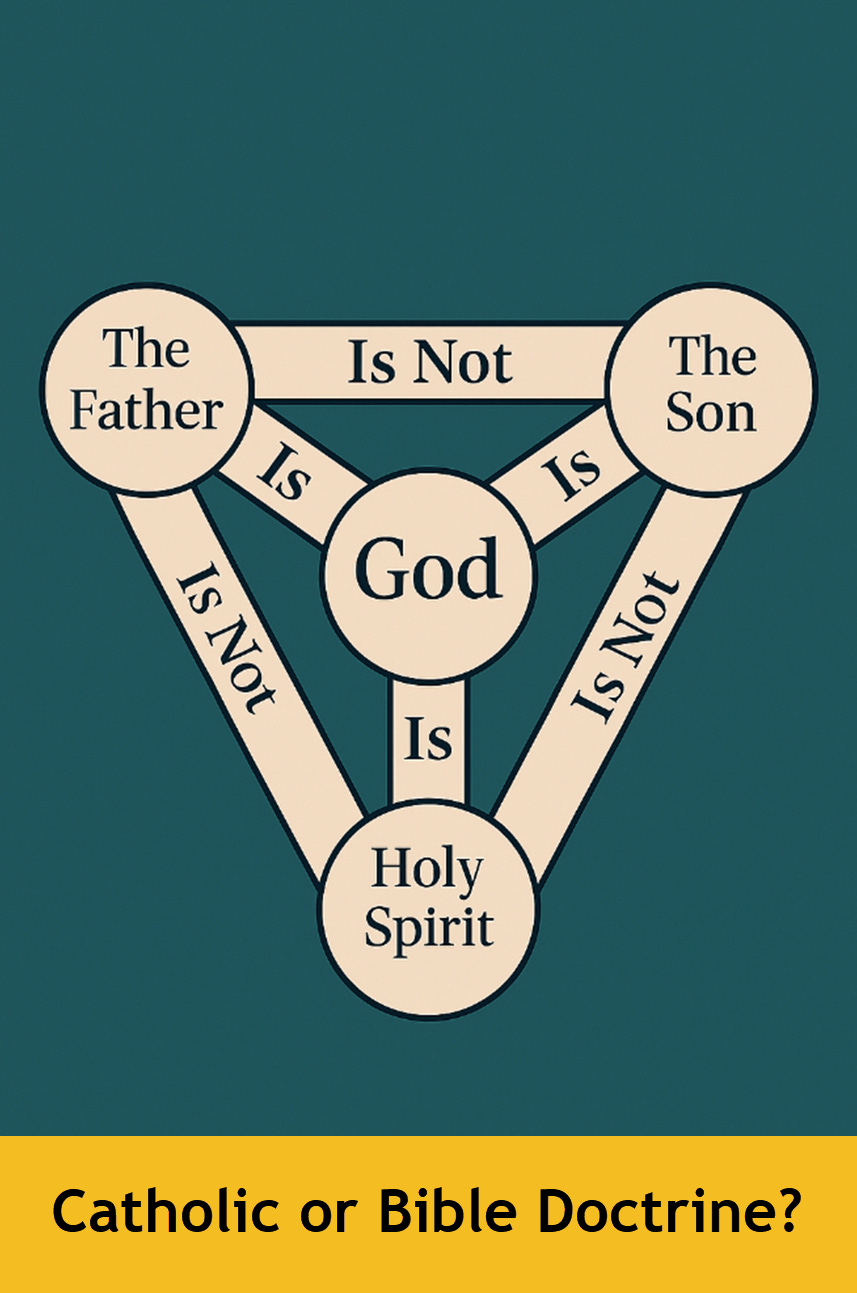

INTRO
Most Christians today uphold the doctrine of the trinity. The definition of this doctrine varies slightly from one church or denomination to the next, but it is generally understood to be a belief of one God that exists in the three persons of the Father, the Son (Jesus), and the Holy Spirit, and that these three beings are all fully and equally God and that none existed before the other (coeternal, coequal).
However, we must ask the question: is the above definition for this doctrine built from Bible verses that uphold and solidify each particular, or are the strongest arguments for this doctrine drawn from another source?
Many will explain the trinity as being a “mystery” that we simply can’t understand in full, but that we must accept in faith. True faith, must ultimately be rooted in the word of God:
“So then faith cometh by hearing, and hearing by the word of God.” (Romans 10:17, KJV)
The question of the trinity is not simply whether there is a Father, a Son, and a Holy Spirit. If the doctrine were simply that, there would be no questions as the Bible has ample evidence of there being a Father, a Son, and a Holy Spirit.
This article will briefly compare what the Bible says about certain points related to the doctrine of the trinity and what the Catholic Catechism has to say. It will then be left for each reader to decide if their understanding of this doctrine is truly rooted in the Bible, or something else.

THE CENTRAL MYSTERY
The Catholic church says the “Most Holy Trinity” is the central mystery of Christian faith and life. Catholic Catechism 234, p.62:
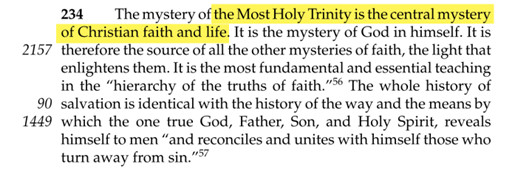
The Bible speaks of mysteries that are related to and pointing to Christ, but is silent on any mystery pertaining to the Father, Son, and Holy Spirit:
“Even the mystery which hath been hid from ages and from generations, but now is made manifest to his saints: To whom God would make known what is the riches of the glory of this mystery among the Gentiles; which is Christ in you, the hope of glory:” (Colossians 1:26–27, KJV)
“Now to him that is of power to stablish you according to my gospel, and the preaching of Jesus Christ, according to the revelation of the mystery, which was kept secret since the world began, But now is made manifest, and by the scriptures of the prophets, according to the commandment of the everlasting God, made known to all nations for the obedience of faith:” (Romans 16:25–26, KJV)
“How that by revelation he made known unto me the mystery; (as I wrote afore in few words, Whereby, when ye read, ye may understand my knowledge in the mystery of Christ)” (Ephesians 3:3–4, KJV)
“For this cause shall a man leave his father and mother, and shall be joined unto his wife, and they two shall be one flesh. This is a great mystery: but I speak concerning Christ and the church.” (Ephesians 5:31–32, KJV)
“Withal praying also for us, that God would open unto us a door of utterance, to speak the mystery of Christ, for which I am also in bonds:” (Colossians 4:3, KJV)
The Bible speaks of Babylon the Great, the Mother of Harlots (a false system of Christianity and doctrines) as being associated with “mystery:”
“And upon her forehead was a name written, MYSTERY, BABYLON THE GREAT, THE MOTHER OF HARLOTS AND ABOMINATIONS OF THE EARTH.” (Revelation 17:5, KJV)

THE ONE TRUE GOD
The Catholic church says the “one true God” is the “Father, Son, and Holy Spirit.” Catholic Catechism 234, p.62:
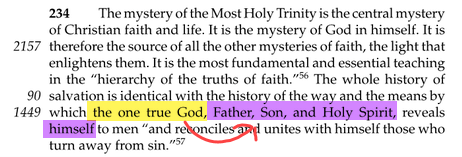

Jesus says the “only true God” is the “Father” alone:
“And this is life eternal, that they might know thee [, Father,] the only true God, AND Jesus Christ, whom thou hast sent.” (John 17:3, KJV)
“Jesus saith unto her, Touch me not; for I am not yet ascended to my Father: but go to my brethren, and say unto them, I ascend unto my Father, and your Father; and to my God, and your God.” (John 20:17, KJV)
The Bible says the “one” true God is the “Father” alone, distinguishing Him from the Son and the Spirit:
“But to us there is but one God, the Father, of whom are all things, and we in him; AND one Lord Jesus Christ, by whom are all things, and we by him.” (1 Corinthians 8:6, KJV)
“There is one body, and one Spirit, even as ye are called in one hope of your calling; One Lord, one faith, one baptism, One God and Father of all, who is above all, and through all, and in you all.” (Ephesians 4:4–6, KJV)
“For there is one God, AND one mediator between God and men, the man Christ Jesus;” (1 Timothy 2:5, KJV)

ROLES OR LITERAL
The Catholic Church says that Jesus is only the “son” of the father in a relational name (metaphorical, symbolic, or role) sense of the term. Catholic Catechism 255, p.67:
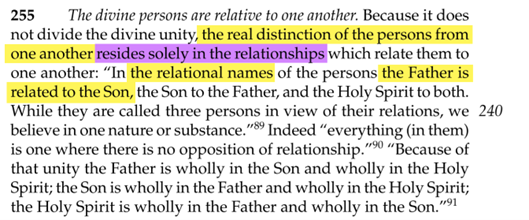
The Bible says that God the Father gave his literal, only begotten Son for the sins of the world:
“For God so loved the world, that he gave his only begotten Son, that whosoever believeth in him should not perish, but have everlasting life.” (John 3:16, KJV)
The Bible says that He was a Son before his incarnation:
“Who hath ascended up into heaven, or descended? Who hath gathered the wind in his fists? Who hath bound the waters in a garment? Who hath established all the ends of the earth? What is his name, and what is his son’s name, if thou canst tell?” (Proverbs 30:4, KJV)
“For what the law could not do, in that it was weak through the flesh, God sending his own Son in the likeness of sinful flesh, and for sin, condemned sin in the flesh:” (Romans 8:3, KJV)
“And again, when he bringeth in the firstbegotten into the world, he saith, And let all the angels of God worship him.” (Hebrews 1:6, KJV)
The Bible says that the teaching which denies the literal relationship between the Father and the Son is anti-christ:
“Who is a liar but he that denieth that Jesus is the Christ? He is antichrist, that denieth the [literal] Father and the [literal] Son. Whosoever denieth the Son, the same hath not the Father: (but) he that acknowledgeth the Son hath the Father also.” (1 John 2:22–23, KJV)

GREATNESS OF AUTHORITY
The Catholic church does not acknowledge any distinction in the father being greater than the son. Catholic Catechism 266, p.70:
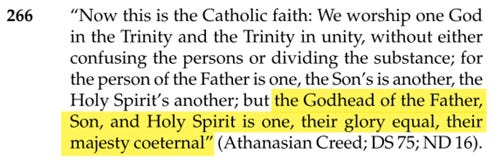
Though the Bible acknowledges the absolute divinity of Jesus,1 Jesus says that the Father is greater in authority than Himself:
“My Father, which gave them me, is greater than all; and no man is able to pluck them out of my Father’s hand.” (John 10:29, KJV 1900)
“Ye have heard how I said unto you, I go away, and come again unto you. If ye loved me, ye would rejoice, because I said, I go unto the Father: for my Father is greater than I.” (John 14:28, KJV 1900)
“Him that overcometh will I make a pillar in the temple of my God, and he shall go no more out: and I will write upon him the name of my God, and the name of the city of my God, which is new Jerusalem, which cometh down out of heaven from my God: and I will write upon him my new name.” (Revelation 3:12, KJV 1900)

CONCLUSION
We’ve covered just a few points here, but in each of them we see the Bible teaching something that is not in alignment with that which the Catholic Church teaches. Yet, it seems that it is the Catholic Catechism, and not the Bible, which provides the strongest arguments for defining and defending the trinity doctrine as it is commonly understood.
This leaves a question for consideration:
Is the trinity a Catholic doctrine or a Bible doctrine? You decide, and may the God of heaven guide you in your prayerful search and study of this matter.

God Bless,
Charles

See also:

